
Nikro Air Duct Cleaning in Hermitage: A Homeowner’s Guide
The difference between a $99 duct cleaning and a $400 one often isn’t effort. It’s whether the machine creating suction is exhausting that air back into your living room or pushing it through a HEPA filter and out of the house. Most homeowners in Hermitage never see the equipment before it shows up in the driveway, so they can’t tell the two operations apart. This guide explains what Nikro equipment actually does inside your ductwork, how negative pressure works, and which questions to ask before you book anyone.
If you’d rather have someone walk you through it, call (855) 726-7834 for a free estimate.
What Does “Negative Pressure” Actually Mean in Duct Cleaning?
Negative pressure means the cleaning unit pulls more air out of your duct system than the system can draw back in, so the whole duct assembly stays under a slight vacuum while the work happens. That vacuum is what keeps loosened dust moving toward the machine instead of drifting into your bedrooms.
Here’s the mechanical picture. A negative pressure unit sits outside or in a service area and connects to the duct system at a single point, usually where the air handler meets the main trunk. The machine’s blower pulls a high volume of air through a filtration stack. Industrial units move anywhere from roughly 1,500 to 4,000 cubic feet per minute depending on the model and the duct size they’re serving. That number matters because a bigger duct system needs more airflow to stay under vacuum than a small one does.
Filtration happens in stages. Coarse pre-filters catch the bulk debris, and HEPA stages downstream trap the fine particulate that would otherwise pass through. HEPA media captures particles at the sub-micron level, which is the same class of filtration used in remediation and hospital settings.
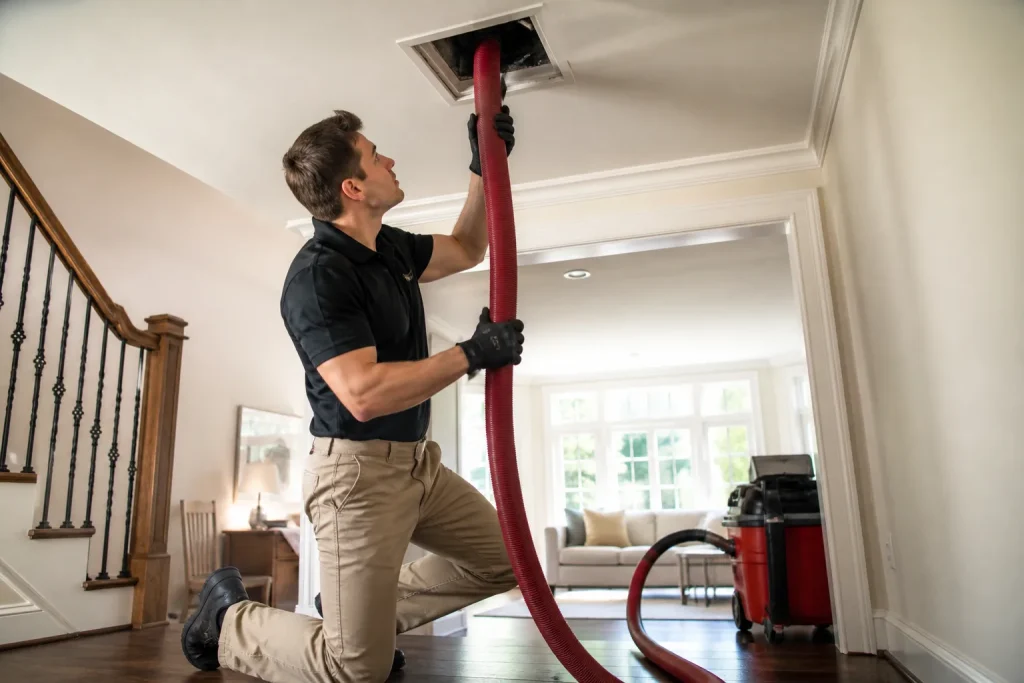
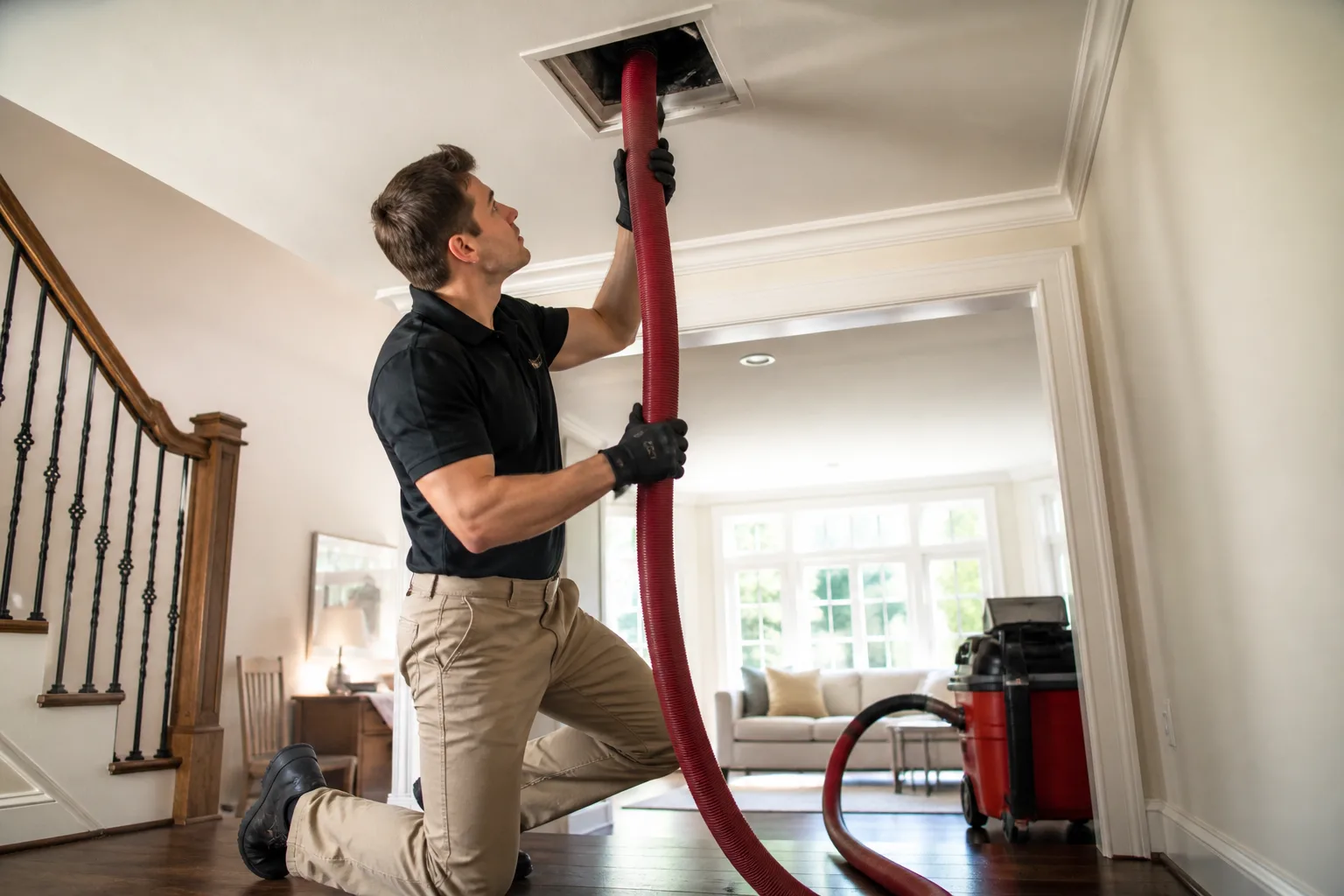
Then there’s exhaust direction, and this is the part homeowners rarely think about. A shop vac or a cheap portable unit often exhausts the air it pulls right back into the room it’s working in. You’ve moved the dust from the duct into the air. A properly set up Nikro unit exhausts through the filter stack to the outdoors. That single difference explains most of the gap between a bargain quote and a real one. When we run air duct cleaning in Hermitage, the exhaust path is one of the first things we set up.
What Nikro’s Pneumatic Agitation Tools Do That Brushes Can’t
Suction alone doesn’t lift caked dust off duct walls. You need agitation to break the bond between the debris and the surface, and the type of agitation matters enormously in flex duct.
Nikro builds pneumatic agitation tools that use compressed air to whip a set of chains or a soft whip head inside the duct. The tool spins and strikes the duct walls from the inside, loosening debris without the tool itself pressing hard against the liner. Compare that to a spinning cable brush. A stiff brush on a cable is effective in rigid metal duct, but in flex duct the brush can catch on the internal wire helix and tear the liner. Once that liner is damaged, the duct becomes a leak point and a collection point at the same time.
What the pneumatic tools give you:
- Contact cleaning without abrasion. The whip head strikes the duct wall, loosens the debris, and moves on.
- Liner-safe operation in flex runs. No rigid brush pressing against a thin plastic membrane.
- Reach into branch runs and short turns where a cable can’t negotiate the geometry.
- Simultaneous agitation and extraction, so loosened material goes straight into the vacuum airstream instead of settling back down.
We use Rotobrush contact-cleaning systems alongside Nikro gear in Hermitage homes, and the two complement each other: one handles the main trunk and rigid runs, the other works the flex branches. The full HVAC cleaning scope also covers the air handler, blower, and coil, because a clean duct connected to a dirty blower stays dirty.
How Do You Verify a Technician Is Running Real Negative Pressure?
You verify it by watching where the machine’s exhaust goes and where the vacuum connects. If the unit is exhausting back into the house, or if there’s no filtration stack visible at all, the negative pressure claim doesn’t hold.
Here’s what to look for before the work starts:
- One machine, one connection point. A proper setup uses a single large vacuum connection to the system, not a small hose taped to one register while the rest of the house is open.
- Visible filter stack. You should see pre-filters and a HEPA housing on the unit itself. Ask what stage catches what.
- Exhaust routed outdoors. The discharge should go outside the conditioned space, not into the garage or the hallway.
- Registers sealed during the work. Every supply and return that isn’t the connection point should be covered. Otherwise the vacuum short-circuits and pulls room air instead of duct air.
- Agitation tools brought in. If the technician only has a hose and a nozzle, no agitation is happening.
- Before-and-after photos of your own ducts. A camera shot of the same run at the start and the end tells you more than any verbal summary.
None of this requires you to know the equipment model numbers. It requires you to look at where the exhaust is pointed and whether the filters are real. In our experience, most homeowners in Hermitage can spot the difference within the first ten minutes of a job once they know what to look for.
Which Nikro Units Handle a Typical Hermitage Home?
Residential jobs in Hermitage are usually served by Nikro’s portable negative pressure units, sized to the duct volume of a single-family house. Light commercial work, such as a small office or a retail space, calls for a larger unit with more airflow and a bigger filter bank.
The distinction matters because a unit that’s too small for the duct system can’t maintain vacuum across the whole run. If the machine can’t keep up, the far end of the system loses negative pressure and debris there just gets stirred around. A properly sized residential unit pulls enough air to hold the entire house under vacuum at once.
Larger commercial units also tend to carry more filtration stages and heavier pre-filter capacity, because commercial duct systems move more air and collect more debris per foot. For a typical Hermitage home, the residential unit is the right tool. For a home with multiple systems, or a finished basement tied into the same ductwork, the sizing conversation changes.
Some homes also call for Abatement Technologies air filtration equipment. That’s source-capture filtration set up in the living space during the work, and it’s appropriate when there’s mold concern, active renovation dust, or recent construction contamination. It’s a different job from standard cleaning, and it should be quoted as one.
What Questions Should You Ask Before Booking Duct Cleaning?
Ask about equipment, exhaust direction, agitation method, and whether the quote covers the whole system. A company that can answer all four without hesitating is running a real protocol. One that can’t is guessing.
A practical list to keep on your phone:
- What negative pressure unit will you use, and where does it exhaust?
- What filtration stages does it have, and is there a HEPA stage?
- What agitation tool do you use in flex duct, and can you show it to me?
- Is the price per system or per vent? (Per-vent pricing is how a small quote becomes a large invoice.)
- Do you clean the air handler, blower, and coil, or just the ducts?
- Will I get before-and-after photos of my own ductwork?
- Do you also handle dryer vent cleaning while you’re here?
That last question is worth its own moment. A clogged dryer vent is a fire-safety issue, not a maintenance nicety, and most duct-only companies don’t touch it. Asking about it in the same call tells you whether you’re dealing with a full air-pathway company or a vacuum with a logo on the side.
When to call a pro
If you can see visible dust puffing from a register when the system kicks on, if a room smells musty when the air runs, if you’ve just finished a renovation, or if it’s been several years since the ducts were cleaned, it’s worth having someone look. Our technicians have up to 14 years of experience and can tell you what they find before any work starts.
Related services in Hermitage: we also handle Hermitage Air Duct Cleaning across the full air pathway, from the HVAC unit to every vent in the house.
The Bottom Line
Nikro equipment matters because of what it does mechanically: it holds your duct system under negative pressure, agitates debris with pneumatic tools that won’t shred a flex liner, filters the airstream through HEPA media, and exhausts outdoors. A shop vac and a spinning brush does none of those things, which is why the two quotes look different. Now you know which questions separate them.
One flat price per system, agreed before work starts. Before-and-after photos of your own ducts. The local pro we connect you with is licensed and insured as their state requires. Call (855) 726-7834 and we’ll get you a free estimate.
Frequently Asked Questions
Most residential duct cleaning in Hermitage runs on a whole-system basis rather than a per-vent price, and the written estimate you receive sets the final number. Be wary of any quote built per vent, since that structure is how a small advertised figure turns into a much larger invoice once the technician is on site. Call (855) 726-7834 for an exact quote. Estimates are free.
Cheap quotes usually skip the negative pressure unit, the HEPA filtration, or the agitation tools. What’s left is a hose and a shop vac, sometimes exhausting the dust right back into the room. The work looks similar on the surface and leaves the ducts largely as they were. Call (855) 726-7834 for an exact quote. Estimates are free.
Ask for before-and-after photos of your own ductwork, taken at the same location. A camera shot of the same run at the start and end of the job is the clearest proof. You should also see the exhaust routed outdoors and the filter stack on the machine before the work begins. Call (855) 726-7834 for an exact quote. Estimates are free.
It depends on the house. A home with pets, recent renovation, or a long gap since the last cleaning tends to need it sooner than a low-traffic home with a well-maintained filter. Visible dust at the registers or a musty smell when the system runs are both reasons to have it looked at. Call (855) 726-7834 for an exact quote. Estimates are free.
Call (855) 726-7834. We answer 24/7. Fast dispatch from 7am to 7pm, Sunday through Friday.
Written by the team at Hermitage Air Duct Cleaning.
Need Air Duct Cleaning Help?
Call Hermitage Air Duct Cleaning - the local pro we connect you with is licensed and insured, with free written estimates in Hermitage.
(855) 726-7834