
Emergency Air Duct Cleaning Near Me: What Hermitage Homeowners Should Do First
If you just found mold at a supply register or a rodent in your ductwork, your HVAC system is actively spreading the problem every minute it runs. The first thing to do isn’t call a cleaner. It’s turn off the system. That single move stops contamination from moving into rooms that are still clean, and it makes the professional cleaning that follows faster and more effective. What you do in the next 30 minutes matters more than which company you dial.
We’ve talked with plenty of Hermitage homeowners who did the exact opposite: fan on, panic rising, phone in hand. Here’s the triage sequence we’d follow ourselves, plus how to tell a true emergency from something urgent but not critical. If you’d rather not sort it out alone, call (855) 726-7834. We answer 24/7.
Why Turning Off the System Comes Before Anything Else
Your HVAC system is a pressure machine. When it runs, it pulls air from the return side, pushes it through the supply trunks, and delivers it to every register in the house. If the contamination is inside that pathway – mold colonizing a wet evaporator coil, rodent droppings on duct liner, soot from a kitchen fire – every cycle distributes it further. Turning the system off removes the engine that spreads the problem.
At the thermostat, choose the off position, not a lower setpoint. Switching to fan-only mode is the worst option; it runs the blower without heating or cooling, which is exactly the scenario that pushes fine particles through the house. If your system has a fresh-air intake or an ERV, close it for now. If you suspect a refrigerant leak or smell something sharp and chemical near the air handler, leave that area and call from outside.
One practical note for a humid Middle Tennessee summer: with the system off, indoor humidity climbs quickly. That doesn’t mean you should turn it back on. If the contamination source is moisture-driven, running the system again before the source is fixed just restarts the cycle.
The Four-Step Triage Sequence: Shut Down, Isolate, Document, Don’t Improvise
Think of it as triage, not repair. The goal is to limit spread, capture what you can, and give a technician a clear picture when they arrive. Here’s the order we recommend.
- Shut down. Thermostat off, fan off, and if you can safely reach the breaker that serves the air handler, turn that off too. Never open the air handler cabinet yourself; there’s live wiring and a blower inside.
- Isolate the source. Close registers in the affected rooms if the system can be run in any mode, or better, keep the system off entirely and shut doors to contain air movement. If you’ve found droppings or a nesting site, don’t vacuum it with a household machine; that aerosolizes what you’re trying to contain. Use a spray bottle of water to dampen visible dust or debris so it stays put, and wear a mask and gloves while you do it.
- Document everything. Photos of the register, the coil, the filter, and the air handler label. A timestamp helps. Write down when you first noticed the symptom – that matters for both the diagnosis and any insurance claim.
- Don’t improvise. Skip the DIY fogger, the ozone generator, and the “just run the fan to clear it out” instinct. All three either spread contamination or introduce a new chemical variable that makes the real problem harder to identify.
That’s the whole sequence. Four steps, five minutes of your time, and you’ve done more than most homeowners manage on their own.
True Emergency or Urgent-But-Not-Critical? How to Tell
Not every alarming symptom means you need someone at the door in an hour. Some do. Here’s how we sort them.
Genuine emergencies:
- Visible mold growth spreading across a supply register, duct liner, or the coil. Mold means moisture, and moisture plus an operating system equals cross-contamination into every room.
- Animal intrusion: a rodent, bird, or squirrel in the ductwork, or evidence of a nest. Animals bring parasites and pathogens, and the debris they leave behind doesn’t stay in one segment.
- Smoke or fire residue contamination from a kitchen fire, chimney backup, or any smoke event. Residual odor and soot move quickly through the system.
Urgent but not critical: a sudden musty smell with no visible growth, a filter that’s clearly never been changed (they happen), visible dust blowing from a register, or a noticeable drop in airflow. These deserve prompt attention but not panic. A scheduled cleaning will handle them.
If what you’re seeing is more about the dryer than the ducts, a clogged dryer vent cleaning is a separate safety issue with its own urgency signal – lint visible at the exterior vent flap, clothes taking two cycles to dry, or the dryer body getting unusually hot.
What to Have Ready When You Call
This is the part most homeowners skip, and it’s the part that decides whether the technician arrives with the right setup. Before you dial, gather:
- Photos of the register, the filter, the air handler label, and any visible contamination.
- Approximate age of your HVAC system and the brand name off the label. This tells the technician what compatible equipment and connections they’ll need.
- A symptom timeline. When did the smell start? Was there a recent renovation, water event, or animal sighting? Did symptoms appear right after a filter change or a service call?
- What you’ve already done. Tell the dispatcher if you turned the system off, if you dampened debris, and if there’s any chemical product in use.
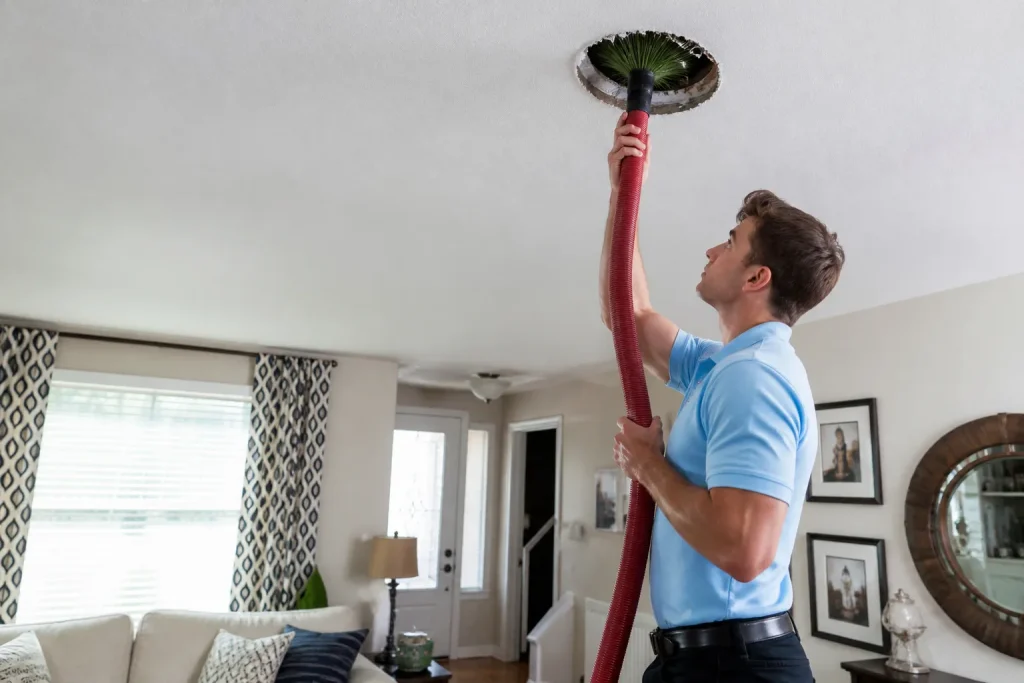
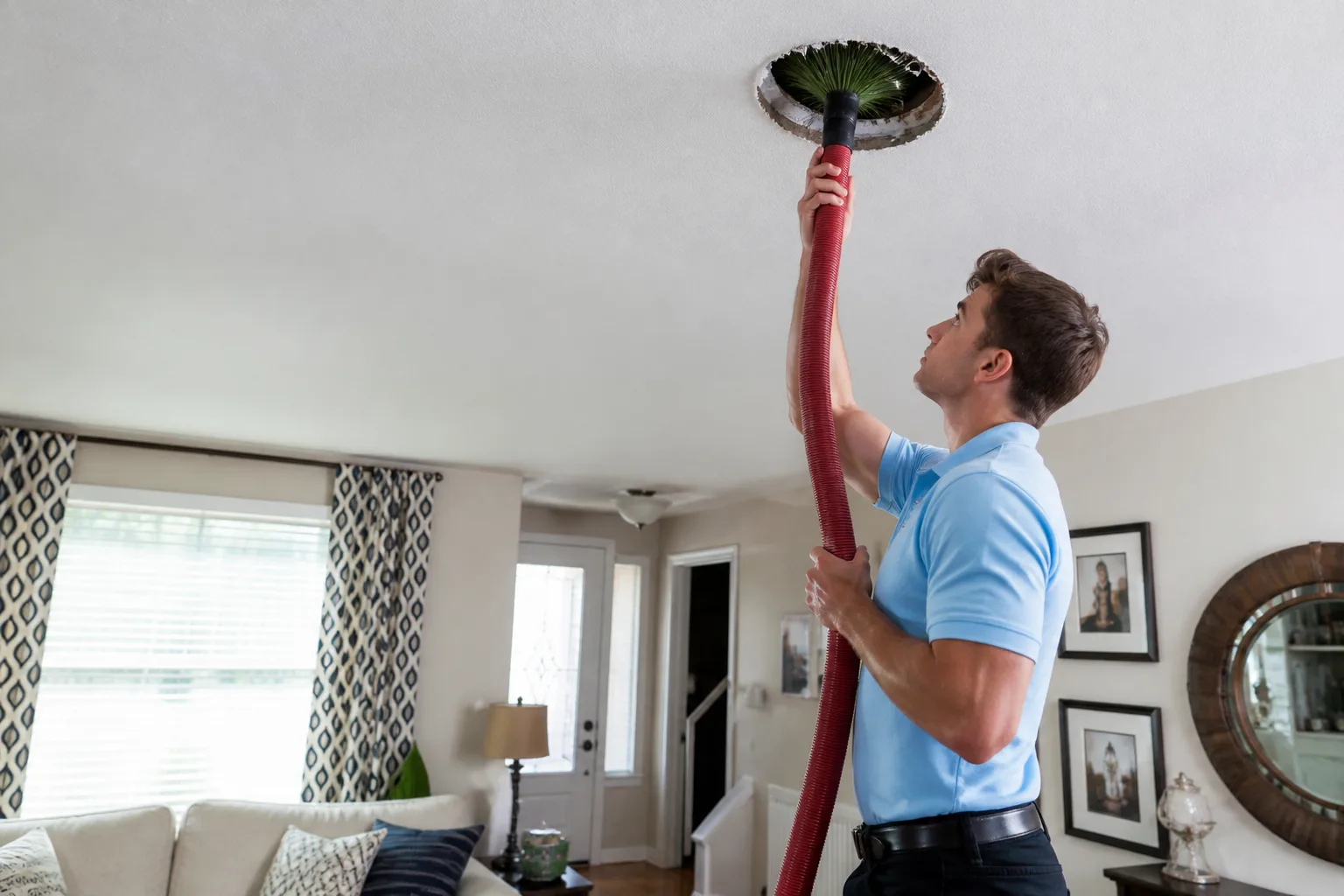
That’s the kind of detail that lets a pro know whether to bring a Rotobrush contact-cleaning setup, a HEPA extraction unit, or Abatement Technologies source-capture filtration. Same-day jobs require planning that a scheduled job doesn’t, because the technician has to think about containment and staging before they arrive, not after.
Why Same-Day Jobs Need Different Equipment Planning
A scheduled cleaning is a deliberate process. A same-day emergency call is a containment operation first and a cleaning operation second. That difference in setup affects both scope and cost.
For a scheduled air duct cleaning, the technician works through the whole system methodically – return side, supply side, registers, and the air handler. For an emergency, the first priority is source capture: locking down the active problem before it spreads. That may mean bringing in negative-air equipment and filtration rated for contamination-sensitive environments, sealing off the contaminated section, and cleaning the immediate pathway before the wider system gets attention. Sometimes that means the cleaning is staged across two visits.
For a full-sized system in a home with a basement or attic air handler, connecting the equipment for a full-system extraction takes setup time that a smaller system doesn’t. Scope is always quoted per system. We don’t quote per vent, because in an emergency, per-vent math quickly turns into a bill you didn’t expect. Every job we dispatch is priced from a written estimate before work starts, and that estimate is free.
Documenting for Insurance Before the Work Begins
If the contamination traces back to a covered event (a burst pipe, water intrusion, a fire), document before anyone cleans. Once the debris is gone, the evidence is gone too.
- Photograph the contamination source with something for scale in the frame.
- Keep the old filter – sealed in a bag, labeled with the date.
- Photograph the exterior vent flap and any water staining near the air handler.
- Ask the technician for a written description of what was found, in plain language.
We’re happy to provide that description. We can also coordinate with your insurer. What we won’t do is claim we handle the claim for you. That’s between you and your policy. If you’ve never had the system cleaned, the first deep cleaning may also reveal repair issues – cracks in flex duct, gaps at connections – that weren’t visible before. Duct sealing closes those gaps and ought to be part of the same conversation.
When to Call a Pro
If the contamination is visible, smells, or involves animals or smoke, stop reading and call us. We’ve seen homeowners try to solve this with a shop-vac and a prayer – the shop-vac didn’t help, and the prayer was answered in the form of a bigger cleanup. Our technicians have up to 14 years of experience, and they arrive with professional-grade Rotobrush and Nikro equipment, not a rented vacuum.
Related services in Hermitage: HVAC cleaning, which covers the coil and air handler side of the problem – not just the ductwork itself.
The Bottom Line
Emergency duct cleaning is a triage sequence, not a panic call. In order: shut the system off, isolate and contain the source, document everything with photos and a timeline, and skip any DIY fogging or fan-based “clearing.” Then call – with photos, HVAC age, symptom timeline, and a list of what you’ve already done. That information lets the right equipment show up on the first visit.
Hermitage Air Duct Cleaning works across the full air pathway – cleaning, sanitizing, sealing, repairing, and dryer vent safety – so one call handles the whole system rather than one segment of it. If you’re in Hermitage and need help, we offer free estimates. Call (855) 726-7834. We answer 24/7. Fast dispatch from 7am to 7pm, Sunday through Friday.
That’s how you turn an emergency into a controlled cleaning. Our Hermitage Air Duct Cleaning team would rather talk through your situation than have you guess.
Frequently Asked Questions
Yes. Turn the system off at the thermostat, and if you can safely reach the breaker for the air handler, turn that off as well. Running the system with mold present spreads spores into rooms that are still clean. Leave the air handler cabinet closed; there’s live wiring and a blower inside. Call (855) 726-7834 for an exact quote after you’ve shut it down – estimates are free.
We don’t quote per vent or price emergency work higher than scheduled work. Cost is based on the full system, determined by a written estimate before any work starts. What drives the range is system size, level of contamination, and whether source-capture filtration is needed. Call (855) 726-7834 for a free estimate and we’ll walk through what your specific job involves.
Low advertised prices often come with a small base fee and add-ons once the technician is on site – extra per-vent charges, “sanitizing” upcharges, and other line items that weren’t in the original number. One flat price per system, agreed before work starts, is the honest structure. Ask any company for the written estimate before they pick up a hose. For ours, call (855) 726-7834 – estimates are free.
Request before-and-after photos of your own ducts, not stock images of clean-looking ductwork. A professional cleaning should be documented with images taken at the registers and inside the system. We provide before-and-after photos as part of the job record. Call (855) 726-7834 to schedule an estimate and see what your system looks like on the inside.
Written by the team at Hermitage Air Duct Cleaning.
Need Air Duct Cleaning Help?
Call Hermitage Air Duct Cleaning - the local pro we connect you with is licensed and insured, with free written estimates in Hermitage.
(855) 726-7834